
Three Left the Nest
A short story

This story was originally published in The Rialto Books Review Vol. 26.
Download this story (for free!) as a PDF or EPUB.
“See how she plunders the hanging basket? The material is perfect for her nest: strong, dry, fibrous. Look, there she goes, a few fibers in her beak and off to her nest.”
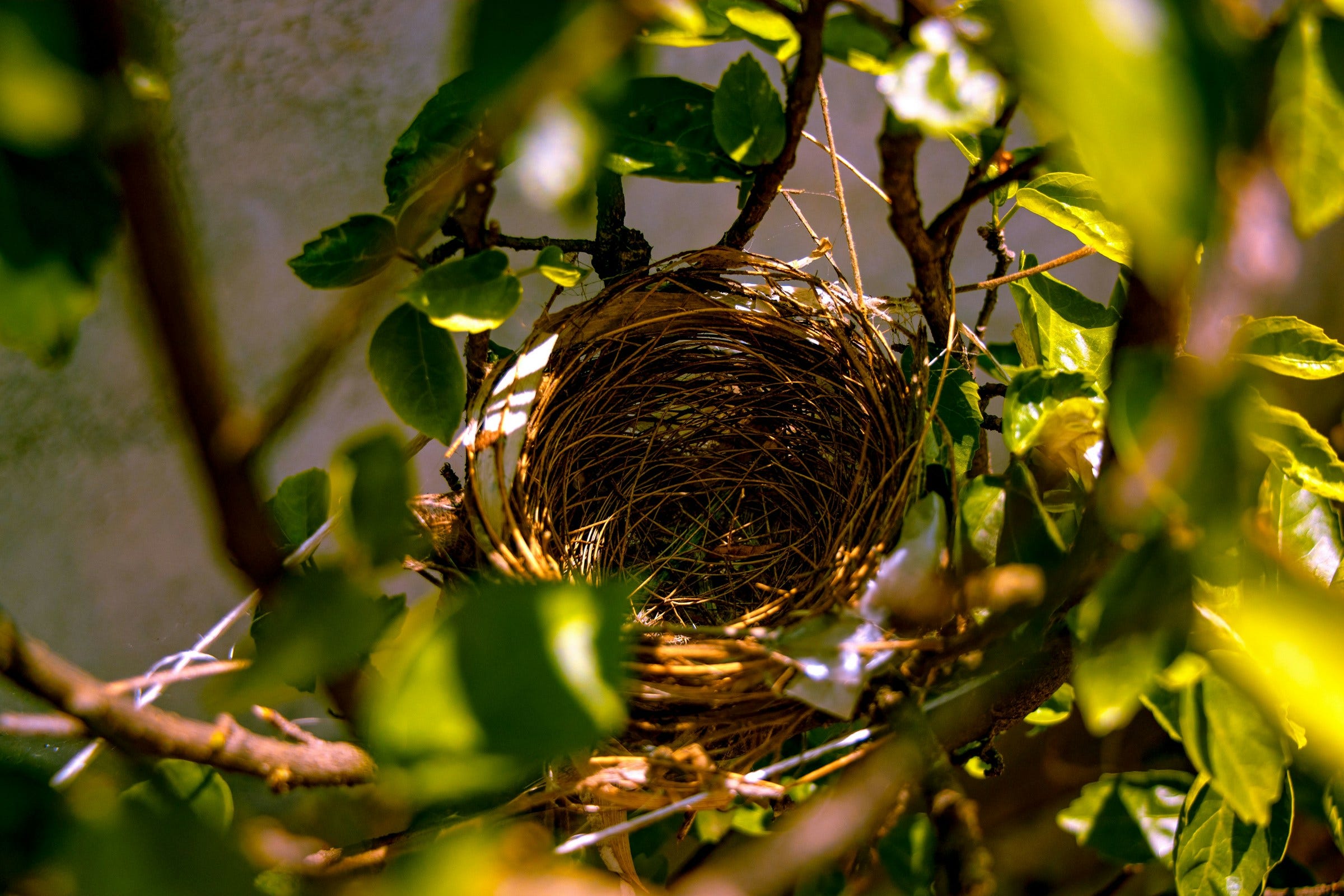
Stephen spoke to Mary sitting in his lap as they looked out the open window, watching as the robin flew to her nest in the crook of a low branch in the elm a few yards away.
Stephen was short and wiry but strong with healthy, bronzed skin and a high brow that gave him an intelligent, cultured air. Mary showed many of the same traits but with brown eyes and lower brow, both inherited from her mother.
“Now she brings the fibers to the nest and, inserting them with her beak, she uses her wrists—the radiale, ulnare, metacarpus, and basal phalanx, roughly where the alula, the ‘little wing,’ which is the bird’s thumb, sits—and she presses the fibers into the nest, turning, turning to press it evenly all around and using her body to do the same.”
“What’s her name again?”
“Turdus migratorius, the American robin, so named because of the resemblance to the European robin but they are not actually of the same species, the European being erithacus rubecula of the muscicapidae family although both are of the order of passeriformes. The American robin was named such simply because of its resemblance to its European cousin.”
The little girl squirmed in his lap and shook her head, sending a flurry of dark curls swirling.
“No, her name.”
“I suppose you can call her whatever you like. I hadn’t given her a name.”
“I want to call her Lucy.”
“Lucy it is, then, dear.”
***
“Come here and I will lift you up.”
A few weeks later the sun blazed away on the emerald green lawn, a fine July morning, the early vapor and dew long since having burned away, the cool morning air replaced with a warm, earthy-smelling atmosphere. The sky, a true sky-blue, held here and there swaths of thin cloud that sped along in the generous breeze.
Taking Mary in his arms, the two of them stood close to the elm and Mary leaned forward, craning her neck to see.
“A fine clutch of eggs; four in all. We shall see how many hatch, perhaps in just a few days’ time.”
“What do you mean that we will see?”
“Despite her best efforts, not every egg will necessarily hatch. They may all, but they may not. It’s just the way it is.”
***
“See?” Stephen said as they stood by the elm a few days later, studying the tiny bald birds, eyes still closed, lying in the nest and breathing with a quick but steady rhythm. “Three hatchlings and still one perfect egg, unhatched.”
“Poor mama,” Mary said.
“Why?”
“She’s probably sad that the one didn’t hatch.”
“It may yet. But why do you think she’s sad?”
“It’s her egg. Her baby. She worked so hard and one didn’t make it.”
“Yes, but you are projecting onto Mama Lucy feelings she probably doesn’t have. She feeds the little ones that hatch, cares for them, but why? Simply survival. The great engine that pushes each of us along, all animals everywhere, but she does not weep for her unhatched chicks. She may, in time, simply push the unhatched egg from the nest and focus all her attention on the hatchlings. What else can she do? No! Go away, Princess!”
The dog, a Labrador mix with a shiny black coat, had leaped up placing her forepaws on the trunk of the elm, tongue lolling, trying to reach the helpless chicks in the nest. Her eyes were bright with interest, her nose twitching as she sniffed over and over to lock in on the scent of the birds. Mama Lucy, having been perched nearby, erupted from the elm and flew off.
“Don’t, Princess!” Mary cried. “Leave them alone.”
Stephen had to nudge the dog hard with his knee to get her to drop down to the ground again and despite their remonstrations she ran around and around the tree barking, eyes fixed on the nest and the unsteady bobbing heads of the chicks.
***
“Oh, Papa, they’ve grown so big!”
“They have, indeed. All gray, downy feathers and bright, open eyes.”
“They make so much noise, too.”
“Of course. They’re hungry and keep their mama busy. See how the one is bigger than the others? I wonder if he was more gifted to begin with; that or he got lucky with feeding. More likely the former rather than the latter; I am inclined to the former: greater inherent strength genetically enables him to push his siblings out of the way.”
Mary was watching the birds and not listening.
“Did you give them names yet?”
“That one’s Rupert,” she said, pointing to the larger of the three. “That one’s Pierrot and that’s Lily.”
“Why Pierrot?”
“Uncle Albert says Pierrot is funny and I think he looks kinda funny.”
“Doesn’t he look just like the other two?”
“No, he’s different,” she said solemnly.
The fourth egg indeed had not hatched and, whether the three chicks had trampled their unhatched sibling, devoured it, or pushed it from the nest was unclear. But the three were in fine form, alert, loud, and growing with astonishing speed such that they seemed bigger each day.
Later that day it rained and Stephen and Mary watched Mama Lucy flit to and fro unable to keep up with the impossible demands of her young who always welcomed her arrival with open mouths as she picked worm after worm from the grass and the stone path and the bare earth of the garden beds, the worms having come up by the hundreds in response to the pattering of the rain.
Stephen and Mary watched the rain, Stephen somewhat disinterestedly, the way that age makes one able to sit and do nothing at all, while Mary was becoming increasingly restless as time went on. The warm, damp air wafted into the living room leaving their skin feeling clammy. Stephen filled his pipe and smoked, thinking, not about the robin and her brood, but of a far-off time on a similarly rainy day when he had run through a forest of close-set trees, the heat stifling, the patter of rain overwhelmed, except in the quiet moments, by volley after volley of gunfire—the harsh report of rifles and the screaming, pinging response of the rounds flying past—with little cover except for muddy holes behind twisted and gnarled roots and stumps and running, running, running when the artillery came splintering trees and men alike.
It had been Sgt. Talbot who had picked up Stephen from behind a tree and Sgt. Talbot who had urged him forward that they might reach inside the range of the artillery and Sgt. Talbot who had fallen, disemboweled, at his feet.
“Dinner-time, Papa.”
Mary’s voice brought Stephen back to the present like the first gasping breath upon emerging from the deep, cold, roiling waters of the plunge pool at the base of a waterfall.
“Be right there, dear.”
Mary scampered off to the dining room and Stephen stayed watching the rain for a few moments more, watching Lucy hop along the grass and pluck an unlucky worm from the ground, squirming and wriggling in her beak, before she took flight up to the crook in the elm’s lower branches and the waiting mouths.
***
“Come on, Papa! Let’s go see Rupert, Pierrot, and Lily.”
Mary opened the French doors and ran out of the living room to the backyard. Princess followed after, barking and yipping as she ran past Mary and went straight past the elm tree and down the slope into the open beyond.
Stephen was sitting on the couch reading a worn tome, The Collected Works of Shakespeare, the page open to Macbeth, an unlit pipe on the end table.
Mary came back through the French doors, her little voice squeaking with excitement.
“Papa, come see! They are all hopping about the nest and the branches. They’re not flying yet.”
Outside, Princess’ barking turned to a shrill, vicious yapping.
Stephen was across the room and out the doors before Mary even turned around.
He sprinted across the yard and got a hand on Princess’ collar but the damage was already done.
Three young little robin bodies lay on the ground, totally still yet striking with their red breasts. One bled from its neck, another from two punctures to its chest, the third was disemboweled.
Princess panted and strained against Stephen’s grip. He pulled her back and across the yard into the house.
“Wait, Mary,” Stephen said, but when he came back out, closing the French doors behind him, Mary was crying over the dead robins.
“I’m sorry, Mary.”
“Why did she do that, Papa?” She hugged her father’s leg.
“She can’t help herself. She’s not a lamb, she’s a dog and dogs kill. They are predators.”
“Not Princess. I don’t like that Princess kills.”
They both stood there for a few moments. Stephen watched Mama Lucy hopping around the tree branches anxiously. He wondered what she felt, if anything.
“What are we going to do?” Mary said.
“We can bury them.”
Mary nodded.
“Do you want to help?”
She shook her head.
“Alright. I’ll get the shovel.”
Stephen dug solemnly, trying not to think back to the other graves he had dug for fallen comrades, friends, a friend who had saved his life.
Three dead young robins lay in the shallow grave, quickly disappearing under the cascading dirt. Mary stood and watched while Stephen patted the earth with the back of the shovel and placed a large sand-colored rock on top of the grave.
They stood awkwardly looking at the stone on the black, freshly-turned earth until Mary said she was going inside.
Stephen remained for a minute more.
“Sorry, Mama,” he said to the bird. “It’s just the way things go sometimes. I’m sure you understand. She’s a murderous bitch. She can’t help it.”
The robin sat on a branch that waved ponderously in the wind, making her look as if she was floating, hovering there in the elm, not sure of whether she should stay or go.
She dropped off the branch and disappeared into the grass farther back in the yard. Returning a few moments later clutching a worm in her beak, Mama Lucy hopped around the base of the tree letting out a low, insistent chirp every few seconds, looking one way then the other. Her chirping became more and more insistent and she began uttering, in between low chirps, a high-pitched cry that made Stephen’s heart ache.
“Sorry, Mama. I should have kept a better watch on her after she showed so much interest in your nest. I wish there was something I could do for you.”
***
The next day, from the window, Stephen watched Mary throwing a ball to Princess, who ran as hard and as fast as she could to chase it down and returned it, lovingly, to the little girl. Mary giggled when Princess’ jaws would snap closed on thin air and applaud when she skillfully caught the ball.
Mama Lucy was nowhere to be seen and a few days later Stephen found the nest on the ground. He suspected Mary had knocked it from the tree.
In time, Mary forgot about the little baby robins altogether, or seemed to. Sometimes he thought he would catch her looking at the spot where he’d buried them.
Stephen could not forget. He ruminated from the window on his failure—was it a failure of imagination or of perception or of attention?—and ruminated on what might have been were it not for those snapping jaws, those slicing teeth, those howling rounds, those bursting shells, except this time, he felt responsible; indeed, he was responsible for those three lives cut short, for Mary’s changed perception of Princess, for Mary’s re-introduction to death while yet so young.
To fight with nature and death and time was an impossible task. Mary would grow up and he would grow old and in time she would lose her father, her only parent. There was time yet, but it moved so quickly. He hoped she would be ready when the time came to put him in the ground. He hoped she would put him in the ground and walk away just like she did with the little robins and not ruminate. Life was for living, a lesson Stephen, tucked away from the world in his little house with his Shakespeare and pipe, had forgotten.
Stephen lit the pipe, leaned back in his chair in the dim evening, and light read aloud:
“They have tied me to a stake; I cannot fly, but bear-like I must fight the course.”
Just then, Mary and Princess came running in, and Mary crawled onto his lap and begged him to read her a fairytale before bed.
Stephen obliged and, for a time, the stake receded to a dark corner of his mind.